1. Pencils, Paper & Tools
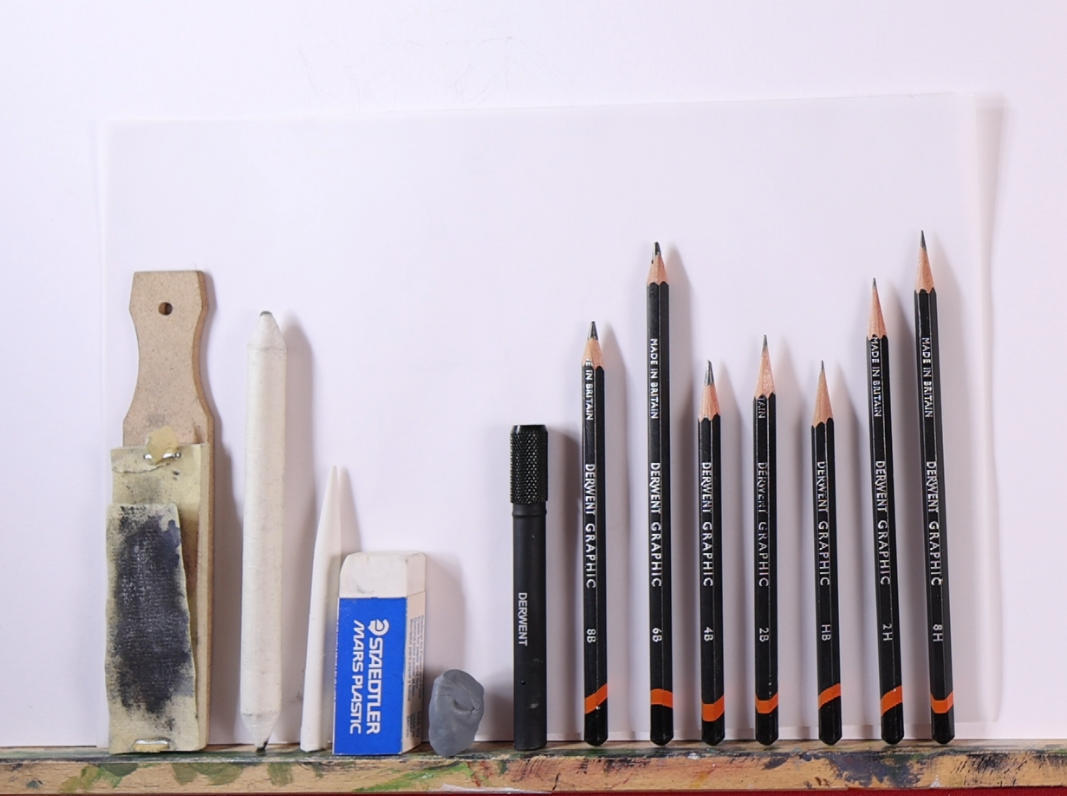
You don’t need a lot to get started
Pencils
Lets start with pencils. You have probably got an HB pencil lying around and you may have seen other pencils like 2H $B etc. The HB is balance of clay binders and graphite the higher the B is say 4B, 6B the more graphite it has and the less clay. This gives a richer darker effect and the pencils is very soft and does not hold a point well. As we go toward 2H, to 6H we have more clay and less graphite. this makes the pencil harder and takes a point really well. It also males the lines more subtle and not as dark.
Even professional pencils like the Tombow Mono 100 ranger are only about £2 each and these have a more consistent finer quality and sharpen more easily. However a good sharpener is your friend I have a usb powered on and a the rather bizarrely named KUM Automatic Long Point shartpener which uses two blades on to remove the wood around the lead core and one to sharpened the actual graphite for about £4
Tools
Then there are erasers. I have two here a grey lump of what looks like blu-tack, a putty rubber, and an eraser you might have in that same drawer as your HB pencil. The putty rubber can be formed into shapes to create an edge or point to carefully erase a small area.
The two white pencil like things next to the erasers are called stumps from the French to smudge. These are tightly wound rolls of paper and can either smudge what is on the paper or you can take a pencil and use a bit of sandpaper (on the left) to create some graphite particles and dip the stump in them and apply that.
I also occasionally use a bit of clean chamois leather and use that to smudge on large areas of graphite to create an even but random areas of shading on larger works.
A good set of pencils say from Derwent with all the erasers stumps etc will maybe cost about £10 from somewhere like Hobbycraft to get you started.
Paper
Your choice of paper is going to influence the outcome of your drawing and there are a number of factors to consider depending on the style you are after:
Whiteness. A pure white paper can make your drawings like more clinical or harsh, I prefer a slightly warmer or natural white to work on often just labelled as white
Grain is how lumpy the paper is. A smoother texture allows for more detail where a coarser grain creates a looser feel.
This is all down to personal choice, there is no right answer.
Two other factors are important in choosing paper, the weight of the paper and the quality. Weight is measured in terms of grammes per square metre (gsm). I normally use 200-300gsm to create something that is stiff that I can draw on without deforming the paper even when pressing hard. Quality determines how even the paper is and how well it stands up to hard erasing without damaging the surface. You wont really paper advertised for sketching anything designed fopr watercolours is just as good for pencils. A good basic paper I often used in the past for many of my works on this site is Daler Rowney Fine Grain Heavyweight which works out about 50p a sheet.
The other paper it’s essential to have ais a bit of clean scrap to out under your wrist so you don’t smudge your work. I am left handed and even though I work right to left to minimise going over what I have drawn.